Self-Balancing Robot
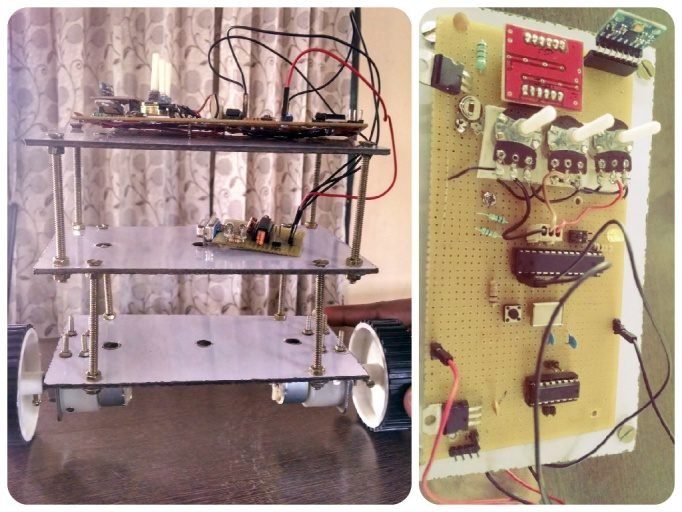
Image: Two wheel balancing.jpg by Mitultakiar via Wikimedia Commons, CC BY-SA 4.0
A robot that stays upright on just two wheels, with no third support point, is a genuinely different control challenge from a standard wheeled robot — it has to continuously correct itself the instant it starts to tip.
This project builds a two-wheeled robot that uses an MPU6050 accelerometer/gyroscope to continuously measure its tilt angle, feeding a PID control loop that adjusts motor speed and direction dozens of times per second to keep the robot balanced upright, similar in principle to a Segway.
How It Works
- The MPU6050 reports the robot's current tilt angle relative to vertical, combining accelerometer and gyroscope data for a stable, low-noise reading.
- A PID control loop compares the measured tilt against the upright (zero-degree) target and computes a correction value.
- That correction sets motor speed and direction — if the robot tips forward, the wheels drive forward to move the base back under the center of mass, and vice versa for backward tilt.
- This loop runs continuously at a high update rate, since any delay in correction lets the robot tip too far to recover.
Components
Arduino Uno/Nano
MPU6050 accelerometer/gyroscope
Motor driver (L298N) + 2x DC gear motors + wheels
Chassis (narrow, two-wheel base)
Battery pack
Applications
- Educational platform for PID control and inverted-pendulum dynamics
- Foundational technique behind self-balancing personal transporters
- Robotics competition entries
Advantages
- Demonstrates real-time closed-loop PID control in a visually obvious way
- Compact two-wheel footprint compared to standard four-wheel robots
- Strong, memorable project demo — balance failure/success is immediately visible
Sample Code — Tilt-Based PID Balance Control
// Simplified self-balancing PID outline - Arduino + MPU6050 #include#include MPU6050 mpu; float kP = 20, kI = 0.5, kD = 0.8; float errorSum = 0, lastError = 0; void loop() { float tiltAngle = readTiltAngle(mpu); // fused accelerometer + gyro angle float error = 0 - tiltAngle; // target = upright (0 degrees) errorSum += error; float derivative = error - lastError; float motorSpeed = kP * error + kI * errorSum + kD * derivative; lastError = error; driveMotors(motorSpeed); // positive = drive forward, negative = drive backward }
Related Research
Hours
Monday - Saturday: 9:00 AM - 5:00 PM
Sunday: Not Working
Location
2nd Floor, Comptron Arcade, Kallattumukku,
Thiruvananthapuram, Kerala 695012
Book Now
+91 9633118080