Three Phase Fault Analysis System
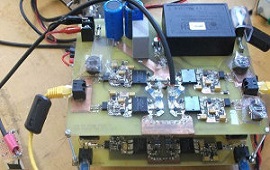
Power system faults are inevitable and must be detected and cleared quickly. This project demonstrates a three-phase fault analysis and classification system. Current transformers and voltage sensors monitor the three phases. During normal operation, all phases have balanced currents. When a fault occurs, the affected phases show characteristic deviations. The Arduino analyzes these deviations to identify the fault type and the phase involved.
Components
Arduino Mega
Current Transformers
Voltage Sensors
Relay Module
16x2 LCD
| Components | Hexkart | Flipkart |
|---|---|---|
| Arduino Mega | Buy Now | Buy Now |
| Current Transformers | Buy Now | Buy Now |
| Voltage Sensors | Buy Now | Buy Now |
| Relay Module | Buy Now | Buy Now |
| 16x2 LCD | Buy Now | Buy Now |

Arduino Mega

The Arduino Mega 2560 is a microcontroller board based on the ATmega2560. It has 54 digital input/output pins (of which 15 can be used as PWM outputs), 16 analog inputs, 4 UARTs, a 16 MHz crystal oscillator, a USB connection, a power jack, an ICSP header, and a reset button. It is the perfect choice for monitoring multiple phases simultaneously due to its abundant analog input channels.
Current Transformer
A current transformer (CT) is used for measurement of alternating electric current. CTs produce a reduced current accurately proportional to the current in the circuit. This makes them ideal for safely measuring high currents in power systems. In this project, three current transformers are used, one on each phase, to monitor the line currents continuously. Any imbalance or sudden change in current pattern indicates a fault condition.
Relay Module
A relay is an electrically operated switch. It consists of a set of input terminals for a single or multiple control signals, and a set of operating contact terminals. The switch may have any number of contacts in multiple contact forms. Relays are used where it is necessary to control a circuit by an independent low-power signal. In this project, relay modules are used to isolate the faulty section once a fault is detected and classified.
Circuit Diagram
Working Principle
The three-phase fault analysis system continuously monitors the voltage and current on all three phases using current transformers (CTs) and voltage sensors. Under normal balanced conditions, all three-phase currents are equal in magnitude and separated by 120 degrees. When a fault occurs, the system detects the anomaly by analyzing the magnitude changes and phase relationship deviations. For example, a single line-to-ground fault causes the faulted phase current to increase dramatically while the other two phases remain relatively normal. A line-to-line fault shows elevated currents on two phases. The Arduino Mega processes the sensor readings and classifies the fault type, then displays the fault type and affected phase on the 16x2 LCD. Relays can be triggered to isolate the faulty section.
Hours
Monday - Saturday: 9:00 AM - 5:00 PM
Sunday: Not Working
Location
2nd Floor, Comptron Arcade, Kallattumukku,
Thiruvananthapuram, Kerala 695012
Book Now
+91 9633118080