RC Sustainable Fishing Drone With Bycatch Avoidance
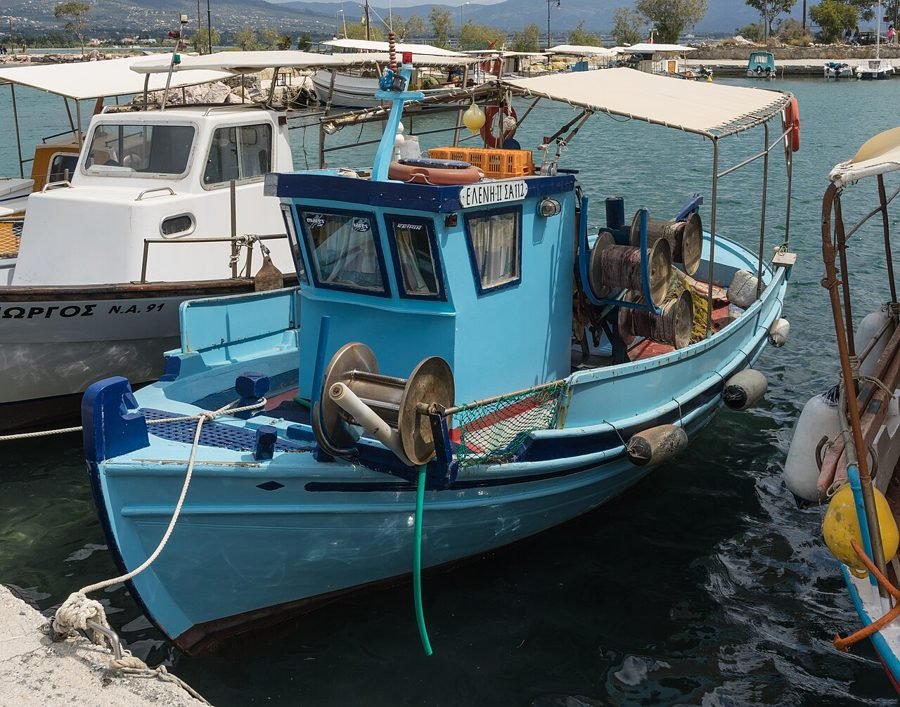
Image: Blue fishing boat harbour Eretria Euboea Greece.jpg by Jebulon via Wikimedia Commons, CC0
Oceans are estimated to produce 50–80% of Earth's oxygen, making sustainable fishing practices genuinely important — and a large share of environmental damage from fishing comes from bycatch: unintentionally catching non-target species using trawler-based methods.
This project builds a remotely controlled fishing drone that lets shore-based anglers reach fish farther out than casting distance would normally allow, without needing a boat or trawler. A camera feed and a line-tension sensor give the operator real-time feedback on what's on the line, and a quick-release mechanism lets an unwanted catch (bycatch) be released before it's fully reeled in, rather than after landing it.
How It Works
- A floating RC hull, driven by a brushless motor and propeller, is piloted out from shore carrying a baited hook and line-release mechanism.
- On reaching the target area (manual RC control, or GPS-waypoint autopilot for a repeatable spot), the drone releases the baited line at that location.
- A waterproof FPV camera and a line-tension/motion sensor give the operator live feedback the moment there's a catch on the line.
- Before fully reeling in, the operator can visually confirm species/size from the camera feed; a servo-actuated quick-release lets unwanted bycatch be released at the line rather than only after landing it.
- A GPS module supports autopilot return-to-shore, so the drone can be recovered even if it drifts from its RC control range.
Components
RC boat/drone hull (floating)
Brushless motor + ESC + propeller
RC receiver or GPS-waypoint autopilot module
Waterproof FPV camera module
Line-release mechanism with servo
Line-tension or motion sensor
GPS module (return-to-shore)
Marine-safe battery enclosure
Applications
- Recreational and small-scale shore fishing
- Marine research and conservation demonstrations
- Reducing trawler dependency for casual/small-scale anglers
Advantages
- Lets shore-based anglers reach deep water without a boat or trawler
- Camera-based catch verification reduces accidental bycatch
- Lower cost and environmental footprint than a full fishing vessel
- GPS-assisted return-to-shore reduces the risk of losing the drone
Sample Code — Line-Release Trigger and GPS Return-to-Shore Check
// Simplified line-release + GPS return-to-shore outline - Arduino
int releaseServoPin = 9;
Servo lineRelease;

struct GPSPoint { float lat, lon; };
GPSPoint shorePoint = {8.5241, 76.9366}; // example shore launch coordinate

void releaseLine(bool release) {
  lineRelease.write(release ? 90 : 0); // open/close quick-release
}

void loop() {
  GPSPoint current = readGPS();
  float distanceFromShore = haversineDistance(current, shorePoint);

  if (bycatchReleaseRequested()) { // operator-triggered from camera feed
    releaseLine(true);
  }

  if (distanceFromShore > MAX_RANGE_METERS) {
    autopilotReturnToShore(shorePoint); // GPS-guided return
  }
}
Related Research
- How much oxygen comes from the ocean? — NOAA
- Benchmarking global fisheries discards — Nature Scientific Reports
Hours
Monday - Saturday: 9:00 AM - 5:00 PM
Sunday: Not Working
Location
2nd Floor, Comptron Arcade, Kallattumukku,
Thiruvananthapuram, Kerala 695012
Book Now
+91 9633118080