Energy Meter with Theft Detection and Billing
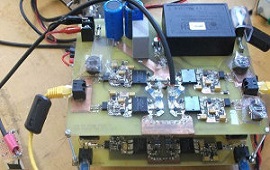
This deployment establishes a distributed metering infrastructure where individual electrical loads report their instantaneous wattage, cumulative kilowatt-hours, and power factor to a centralized cloud dashboard via MQTT protocol. Each node incorporates a non-invasive current transformer and voltage divider to sample the AC waveform, from which a dedicated energy measurement IC computes true RMS values. An ESP32 microcontroller bridges the sensor front-end to the internet through Wi-Fi, publishing time-series data to a cloud broker. The visualization layer renders per-circuit consumption trends, anomaly alerts for abnormal draw patterns, and projected billing estimates. Facility managers leverage this intelligence to identify phantom loads, optimize duty cycles, and enforce demand-side energy conservation policies.
Components
Arduino Mega
ZMPT101B Voltage Sensor
ACS712 Current Sensor (2)
GSM SIM900A
16x2 LCD
| Components | Hexkart | Flipkart |
|---|---|---|
| Arduino Mega | Buy Now | Buy Now |
| ZMPT101B Voltage Sensor | Buy Now | Buy Now |
| ACS712 Current Sensor | Buy Now | Buy Now |
| GSM SIM900A | Buy Now | Buy Now |
| 16x2 LCD | Buy Now | Buy Now |

GSM SIM900A Module

The SIM900A is a quad-band GSM/GPRS module that operates at 900/1800MHz frequencies. It supports voice calls, SMS, and GPRS data transmission. Controlled via AT commands over serial (UART), the SIM900A can send SMS alerts and transmit energy consumption data to a utility server. It requires a standard SIM card and an external antenna. The module operates at 3.4V to 4.5V and needs a peak current of 2A during transmission.
Theft Detection Principle
Theft detection works on the principle of comparing input and output currents. Two ACS712 current sensors are placed: one at the meter input and one at the consumer output. Under normal conditions, the current flowing into the meter equals the current flowing out to the consumer. If a bypass wire is connected around the meter (a common theft method), the output sensor reads less current than the input sensor. The Arduino continuously compares both readings; a difference exceeding a threshold (typically 5 percent) indicates theft. The system logs the event, displays the status on the LCD, and triggers an SMS alert via GSM.
Energy Calculation
Energy consumption is calculated by continuously sampling voltage (via ZMPT101B) and current (via ACS712). The Arduino computes instantaneous power (P = V x I) at regular intervals. By integrating power over time, the total energy consumed in watt-hours (Wh) is accumulated. This value is stored in EEPROM to persist across power cycles. At the end of each billing cycle, the total kWh reading is transmitted via GSM SMS to the utility server for automated bill generation. The LCD displays real-time voltage, current, power, and cumulative energy consumption.
Circuit Diagram
Working Principle
The smart energy meter operates as a complete metering and monitoring solution. The ZMPT101B voltage sensor measures the mains AC voltage, while two ACS712 current sensors measure input and output currents. The Arduino Mega continuously samples all sensor readings, calculating RMS voltage, RMS current, instantaneous power, and cumulative energy consumption. The dual current sensor arrangement enables theft detection by comparing input and output current values. When a significant mismatch is detected, indicating meter bypass tampering, the system triggers an SMS alert via the GSM SIM900A module with the meter ID and timestamp. The LCD displays all parameters in real-time. At the end of the billing cycle, the total kWh reading is sent via SMS to the utility company for bill generation. The system can also disconnect the consumer supply via a relay if theft persists, providing an automated enforcement mechanism.
Hours
Monday - Saturday: 9:00 AM - 5:00 PM
Sunday: Not Working
Location
2nd Floor, Comptron Arcade, Kallattumukku,
Thiruvananthapuram, Kerala 695012
Book Now
+91 9633118080