Bladeless Air Conditioner Fan Using Peltier
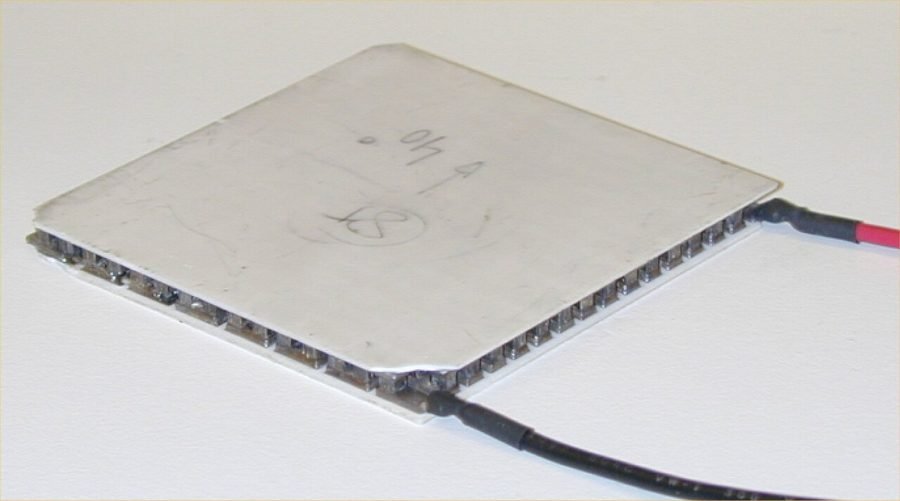
Image: Peltierelement 16x16.jpg by No machine-readable author provided. Bye~commonswiki assu... via Wikimedia Commons, Public domain
Traditional fans have exposed rotating blades — a safety risk around fingers and hair, harder to clean, and often noisy at higher speeds. Bladeless fan designs solve the safety and cleaning problems, but most only move ambient air; this project adds active cooling on top of that.
A Peltier (thermoelectric) module cools an internal heat sink that air is drawn across before being pushed out, while a hidden internal impeller in the base amplifies and directs that cooled air out through a narrow annular slot in the fan's ring — with no exposed blades anywhere in the airflow path.
How It Works
- The Peltier module's cold side is pressed against a heat sink that incoming air is drawn across, cooling the airflow below ambient temperature.
- The Peltier's hot side is actively cooled by its own small heat sink and fan, keeping the module efficient and preventing thermal runaway.
- A brushless impeller, hidden inside the base, draws air in and pushes it up through the body and out through a thin annular slot in the ring-shaped head — accelerating and smoothing the airflow (the Coandă effect) without any visible blades.
- A temperature sensor and PWM control regulate Peltier power and impeller speed together, balancing cooling effect against power draw.
Components
Peltier module (TEC1-12706 or similar)
Heat sinks (cold side + hot side)
Small brushless fan (hot-side heat dissipation)
Internal impeller/blower unit
Temperature sensor (DHT22 or thermistor)
PWM motor driver
DC power supply + bladeless housing/duct design
Applications
- Personal desk cooling
- Compact room cooling
- Homes with children or pets where exposed blades are a concern
Advantages
- No exposed blades — safer around children and pets, and easier to clean
- Quieter operation than a traditional blade fan at comparable airflow
- Actively cools the air (via Peltier) rather than just moving ambient air like most bladeless fans
Sample Code — Temperature-Based Peltier and Fan PWM Control
// Simplified Peltier + impeller PWM control - Arduino
int tempSensorPin = A0;
int peltierPWM = 9;
int impellerPWM = 10;
float targetTempC = 22.0;

float readTemperatureC() {
  int raw = analogRead(tempSensorPin);
  float voltage = raw * (5.0 / 1023.0);
  return (voltage - 0.5) * 100.0; // typical analog temp sensor scaling
}

void setup() {
  pinMode(peltierPWM, OUTPUT);
  pinMode(impellerPWM, OUTPUT);
}

void loop() {
  float currentTemp = readTemperatureC();

  if (currentTemp > targetTempC) {
    analogWrite(peltierPWM, 200);   // active cooling
    analogWrite(impellerPWM, 180);  // push cooled air out
  } else {
    analogWrite(peltierPWM, 80);    // reduced power, maintain temp
    analogWrite(impellerPWM, 120);
  }
  delay(500);
}
Related Research
Hours
Monday - Saturday: 9:00 AM - 5:00 PM
Sunday: Not Working
Location
2nd Floor, Comptron Arcade, Kallattumukku,
Thiruvananthapuram, Kerala 695012
Book Now
+91 9633118080